Reduced Pressure vs Double Check Assemblies Explained
Reduced pressure vs double check assemblies in Yorba Linda CA: how RPZ and DCVA backflow preventers differ, which one your property needs, and how testing works.
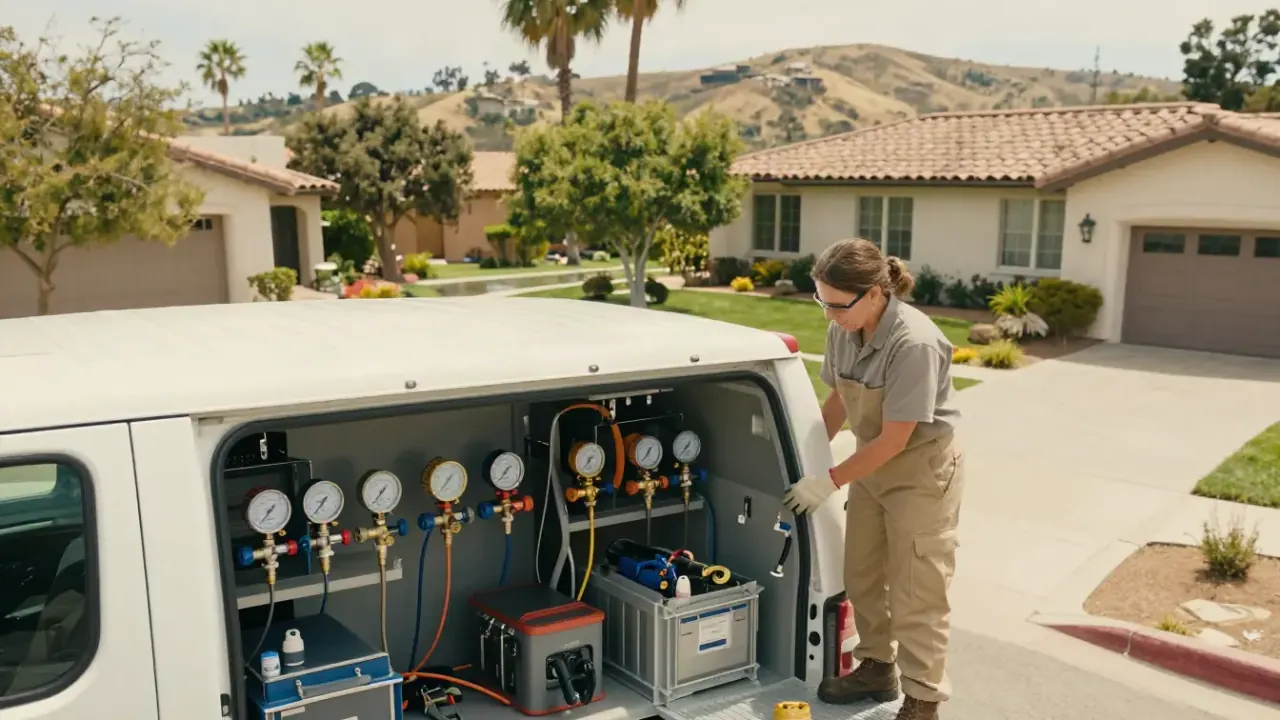
A reduced pressure (RPZ) assembly protects against both backpressure and backsiphonage and discharges water to the ground when it fails, while a double check valve assembly (DCVA) uses two spring-loaded check valves and no relief port, so it only protects against backpressure and backsiphonage where the health hazard is low. That is the whole difference in two sentences. Everything else - the cost, the annual test, the vertical clearance, which one your water agency will accept - flows from that single design choice.
Reduced pressure vs double check assemblies in Yorba Linda CA comes up constantly because this city has a mix of everything: 1960s ranch homes on flat lots, hillside estates in Vista del Verde and Kerrigan Ranch, HOA-managed common areas, and small commercial buildings along Yorba Linda Boulevard. Each one gets a different answer. Below we walk through how each assembly works, which one your property needs, what testing costs in 2026, and the mistakes that get people red-tagged.
The Short Answer: RPZ vs DCVA in One Paragraph
An RPZ is the higher-protection device and a DCVA is the lower-protection device, and the choice is dictated by the degree of hazard your water connection creates, not by preference or price. If your property handles anything that could make someone sick if it entered the public main - irrigation with fertilizer injection, a fire sprinkler line with chemical additives, a commercial kitchen, a dental office, a car wash, a boiler with glycol - you need an RPZ. If your connection only carries potable water that could theoretically be pushed backward by pressure loss, a DCVA is usually accepted.
Yorba Linda sits in the Yorba Linda Water District service area for most residential addresses, with some parcels on adjacent agency lines. Each agency publishes its own approved assembly list and cross-connection control policy, and the inspector who signs your annual test report follows that policy, not a general rule from the internet. That is why two identical houses on the same street can legally carry two different assemblies.
How a Reduced Pressure Assembly Actually Works
A reduced pressure assembly has two independently acting check valves plus a differential relief valve between them, and that relief valve is what makes it a true backflow preventer rather than a check valve pair. Under normal flow, supply pressure holds the relief valve closed. The moment the pressure differential across the first check drops below roughly 2 psi - meaning the downstream side is catching up to the upstream side - the relief valve opens and dumps water out of the bottom port instead of letting it travel backward.
That discharge is the feature, not a defect. When you see water dripping from the relief port on a Yorba Linda RPZ, the device is doing exactly what it was built to do. It is telling you one of the checks is fouled, the relief seat has debris on it, or supply pressure has dropped far enough to trip the differential.
What an RPZ looks like on your property
You will usually find an RPZ as a bell-shaped brass or bronze body with two test cocks on the side and a relief port aimed at the ground or into a drain. It sits above grade, typically 12 inches or more above the surrounding soil, on a concrete pad or a pipe riser. Most residential RPZs in Yorba Linda are 3/4-inch to 1-inch; commercial and fire line units run 1-1/2-inch to 4-inch and larger.
Testing an RPZ
Annual testing on an RPZ checks three things: the first check's pressure drop, the second check's pressure drop, and the relief valve's opening point. A 1-inch RPZ test takes our technicians about 15 to 20 minutes on a clean device. If the relief valve opens too early or a check will not hold, the assembly fails and needs service before the report can be filed as passing.
How a Double Check Valve Assembly Actually Works
A double check valve assembly is two spring-loaded check valves in series inside a single body with no relief port and no atmospheric vent. The first check holds against backpressure from the downstream side; the second check is the backup. Because there is no relief valve, a DCVA cannot discharge anything - it either holds or it leaks past internally, and you will not see it happen.
That silent failure mode is the reason DCVAs are restricted to low-hazard connections. If a check fails on a DCVA feeding a potable-only line, the worst case is untreated but still potable water moving the wrong direction. If a check fails on an RPZ feeding a chemical-injected irrigation line, the relief valve catches it and dumps it on the ground. Different hazard, different device.
What a DCVA looks like on your property
A DCVA is a straight, barrel-shaped body with two test cocks and no bottom port. It is smaller and lighter than a comparably sized RPZ, which is one reason builders like it - it fits in tighter vaults and needs less vertical clearance. On Yorba Linda properties, DCVAs show up most often on residential irrigation lines, on domestic water services to single-family homes, and on some HOA landscape meters.
Testing a DCVA
Testing a DCVA checks the pressure drop across each check independently. A 1-inch DCVA test runs about 10 to 15 minutes. Because there is no relief valve to verify, the test is shorter and the failure modes are narrower - usually a check that will not hold a 1 psi differential, or a fouled seat from hard water scale.
Which Backflow Assembly Do I Need in Yorba Linda California?
The assembly you need in Yorba Linda is determined by the hazard level of your connection, and the practical answer is that irrigation with any chemical injection, fire sprinkler systems, and most commercial uses require an RPZ while plain domestic and non-injected irrigation lines can usually use a DCVA. Here is how that breaks down by property type.
- Single-family home, domestic service only: DCVA in most cases, though some older services were built with an RPZ and stay that way.
- Home with irrigation and no fertilizer injection: DCVA is commonly accepted; some HOAs and the water district still require an RPZ at the point of connection.
- Home or HOA with fertigation or reclaimed water: RPZ, no exceptions.
- Fire sprinkler line: RPZ or a dedicated fire-line detector assembly, depending on the agency and the system type.
- Commercial kitchen, dental, medical, car wash, laundry, boiler: RPZ.
If you are not sure which one is on your property, look at the body. A relief port pointing down means RPZ. No relief port means DCVA. If the tag is missing or unreadable, we can identify it on site and pull the assembly history for you.
We handle both device types routinely, and if you want the full breakdown of what annual service looks like on each, our page on Annual Backflow Assembly Testing Yorba Linda CA covers scheduling, tag replacement, and what the report actually contains.
What Is the Difference Between Reduced Pressure and Double Check Assemblies in Yorba Linda CA?
The difference between reduced pressure and double check assemblies in Yorba Linda CA comes down to three measurable things: protection level, physical footprint, and annual test cost. Protection level we covered above. Footprint and cost are where most homeowners feel it.
Size, clearance, and installation
An RPZ needs vertical clearance for the relief port to discharge - typically 12 inches minimum above grade, and more if it drains into a receptor. A DCVA needs no discharge clearance, so it can sit lower and in tighter spaces. On a hillside lot in Kerrigan Ranch or Vista del Verde, that clearance difference can decide whether the assembly fits in the existing vault or whether the vault has to be rebuilt.
Cost in 2026
Typical 2026 pricing in this area for a 1-inch assembly test runs $75 to $125 for a DCVA and $85 to $150 for an RPZ, because the RPZ test includes the relief valve verification. Replacement assemblies run roughly $250 to $450 for a 1-inch DCVA and $350 to $650 for a 1-inch RPZ, installed. Larger commercial and fire-line devices scale up from there.
Repair frequency
RPZs need repair more often than DCVAs, mainly because the relief valve adds a third moving seat that can foul. In our experience across Yorba Linda, a clean 1-inch RPZ on municipal water typically passes its annual test for 5 to 8 years before it needs a rubber kit, while a DCVA often goes 8 to 12 years. Hard water and debris shorten both numbers.
If your RPZ is tripping or dripping between tests, that is a repair issue, not a testing issue. Our RPZ backflow service Yorba Linda covers relief valve cleaning, check replacement, and re-certification on the same visit whenever the parts are on the truck.
Common Mistakes We See on Yorba Linda Backflow Assemblies
The most common mistakes we see on Yorba Linda backflow assemblies are avoidable, and almost all of them cost the owner a second visit and a second fee. Watch for these.
- Letting the annual test lapse. Most agencies require testing every 12 months. Miss the window and you can get a compliance notice, and in some cases a shutoff notice, even if the device is working fine.
- Painting over the assembly. Paint on the test cocks and relief port seizes them. We have had to replace test cocks on assemblies that were painted the same weekend the house was.
- Burying the assembly or the relief port. Landscaping grows. An RPZ that was 14 inches above grade in 2015 can be 4 inches above grade today, and that fails clearance.
- Swapping an RPZ for a DCVA without approval. This is a code violation and a cross-connection hazard. Do not do it, and do not let a handyman talk you into it.
- Ignoring a dripping relief valve. A drip is a warning. Left alone, it becomes a flooded planter bed and a failed test.
- Losing the assembly tag or test report. Inspectors want the tag number and the last passing report. Keep both.
We also see a lot of assemblies installed in the wrong orientation, or with the relief port discharging into standing water. Both are easy fixes if we catch them at the annual test and expensive fixes if we catch them after a backflow event.
When to Call a Professional
Call a professional the moment your assembly drips, fails a test, gets a compliance letter, or hits its 12-month testing anniversary - those are the four triggers, and none of them get better with time. Backflow testing requires a certified tester with calibrated gauges, and the report has to be filed with your water agency in their format. There is no DIY version of that.
We are a local, certified backflow testing company working throughout Yorba Linda and the surrounding Orange County area. We test RPZ, DCVA, and PVB assemblies, file the compliance paperwork with the water district, and carry common repair parts so a failed device can often be fixed the same day. If you are on a hillside lot in Backflow Testing in Vista del Verde or a flat-lot ranch home near the Town Center, the process is the same - we show up, test, tag, and file.
If your property has multiple assemblies - an irrigation DCVA plus a domestic RPZ, for example - we test them all on one visit and file a single report. That is the norm for most HOA-managed communities here, and it is how we keep the cost per device down.
Frequently Asked Questions
What is the difference between reduced pressure and double check assemblies in Yorba Linda CA?
An RPZ has two check valves plus a relief valve that discharges water when it fails, so it protects against high-hazard backflow. A DCVA has two check valves and no relief port, so it is limited to low-hazard connections. The water agency assigns the required type based on your connection's hazard level.
Which backflow assembly do I need in Yorba Linda California?
Domestic water service and non-injected irrigation usually take a DCVA. Irrigation with fertilizer injection, fire sprinkler lines, and most commercial uses require an RPZ. Your water agency makes the final call based on the hazard level of your connection, not on the size of the building.
Is RPZ better than DCVA in Yorba Linda?
An RPZ provides more protection - it is the higher-hazard device and it discharges rather than passing water backward. But "better" depends on the hazard. Putting an RPZ on a plain domestic line is overkill; putting a DCVA on a chemical-injected irrigation line is a violation.
How do I know if I have an RP or DCVA assembly in Yorba Linda CA?
Look at the bottom of the assembly body. An RPZ has a relief port pointing down, plus two test cocks on the side. A DCVA has two test cocks and no bottom port. If the tag is missing, we can identify the model and pull its history on site.
Can I switch from double check to reduced pressure in Yorba Linda?
Yes, and it is common when a property adds fertigation, a fire line, or a commercial use. You need agency approval and a permit, and the new assembly has to meet clearance and drainage requirements. We handle the swap and the first certification report.
Get Help with Backflow Testing in Yorba Linda
Whether you have an RPZ, a DCVA, or you are not sure which one is bolted to your riser, we can test it, tag it, and file the report with your water agency before the compliance deadline. We serve all of Yorba Linda and the surrounding Orange County area, and we carry the parts to fix most failures on the same visit.
Call Yorba Linda Backflow Testing at (714) 880-7120 to schedule your annual test or to get a straight answer on which assembly your property actually needs.